
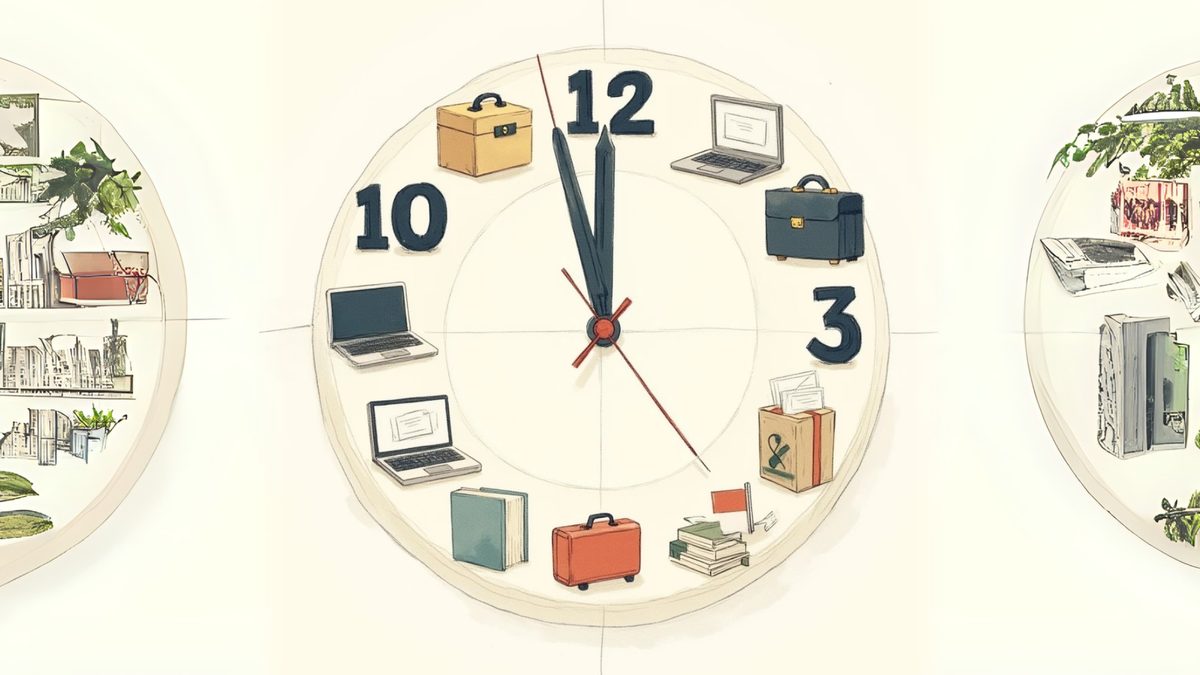
For a typical eight hour workday, plan six hours of tasks. Not six hours of "real work" on top of everything else. Six hours total, including your planning and your email. The remaining two hours go to breaks and lunch, and the gap between six planned and eight available is the slack that absorbs everything you could not predict.
This is the number people argue with and then quietly adopt.
The math
+ 5.5 hours of email, meetings, and tasks
+ 4 breaks at 15 minutes each
+ 1 lunch at 60 minutes
= your 8 hour workday
That is the whole thing. If it looks like it does not leave much room, that is the point. It never did leave much room. You were just not counting the parts that were already spending it.
Every task is planning, communicating, or doing
Group each day's work into exactly three buckets.
Planning is anything requiring your brain, a piece of paper, and a calendar. It is done alone, though it might include a quick question to get an answer. Thirty minutes at the start of every day, writing down what needs doing, personal and professional, then turning that list into your actual calendar.
Every day, because every day something new happens to us. It requires constant small corrections to stay on course.
Communicating is any time spent interacting with another person or responding to a request. Replies in Basecamp or Asana. Email. Meetings, in person or virtual. Client requests in a support queue. Office hours. Check-ins.
This is the most vastly underestimated and unaccounted for part of most days, and getting it under control is one of the hardest things you will attempt. It is also the thing that determines whether the rest of the day works.
Doing is the work you complete by yourself. These are your 90 minute items from the brain dump, dropped into the daily sheets and aligned as best you can with each day's stated focus.
Forty hours was really fifteen
When we brought six-week cycles into the Canadian company that acquired my team, we got to examine one of their engineers' schedules.
Forty hours available per week, on paper.
Once we counted communicating with internal stakeholders, making sure his team had what they needed, and regularly scheduled maintenance time, he had roughly fifteen hours actually available for hands-on development work.
Nobody was slacking. Nobody was disorganized. The forty was simply a number nobody had ever checked, and every plan built on it was going to fail for reasons that would get blamed on the person rather than the arithmetic.
If it feels like your days run away from you and you cannot get much done, this is usually why. Not effort. Accounting.
"Too much comes up" is not an excuse
Organizations fall into the "too much stuff comes up" trap constantly, and use it as a reason not to plan at all because planning seems too hard.
But that is backwards. You do not skip planning because things come up. You plan for things to come up.
Planning six hours in an eight hour day gives every person two hours of flexible time. Some weeks you will not need it. Some weeks you will eat into breaks and lunch, which we do not want but can survive. If two hours is not enough, then explicitly allocate two hours a day to unpredictable work and treat that as a line item.
Then shrink it. Next cycle, try 1.5 hours. The cycle after that, one hour. Keep going until either your unpredictable work is genuinely predictable or you have found the floor. Like meditation, this is a practice, not a state you arrive at.
Parkinson's Law is the engine underneath
Work expands to fill the time you allow for it. We have all known this since school, when a two week assignment got finished in six hours the night before it was due.
Which is why the cycle sheet plans hours before they are spent. Most time tracking software is built around recording time after it has passed, which tells you what happened but changes nothing. Deciding a task gets 45 minutes before you start it is what makes it take 45 minutes.
This is also why the sheet lives in a spreadsheet rather than a calendar. A calendar forces you to commit a task to a specific hour weeks out, and then one change collapses the whole structure like a waterfall. A spreadsheet lets you move a task between days without wrecking anyone's schedule, and it tallies your hours per project in a column so you can see the total before you commit to it.
Protect the doing time
A distraction does not cost you the length of the distraction. It costs you the distraction plus the climb back to where you were.
One frequently cited UC Irvine study puts the recovery at about 25 minutes. I will be honest, that number sounds high to me and we do not know who funded it. But we can agree that a distraction pulls you away and it then takes some amount of time to catch up again. Even at half that figure, two distractions in a morning is a meaningful piece of your day.
In a time-based environment, nobody cares. You are there until five regardless. In a results-oriented environment, two distractions are the difference between finishing at four and finishing at five, and the longer a task takes the less time you have for the things you actually care about.
So block your communication rather than letting it block you. Try checking email at 10am for an hour and again at 2pm for thirty to forty-five minutes. Come in and keep email closed for the first stretch, knock out the first big task, and only then open the tools that will hijack your day. At minimum you will have finished one real thing before the day started happening to you.
And quit the email program when you are not using it. Persistent chat has the same problem in a faster form: it trains everyone to expect an answer immediately, and it turns your most productive people into a help desk for each other.
Be productive, not distracted.
Where this fits
Six hours per day is the constraint you plan against once you have dumped every task and estimated it honestly with the "and then?" game. Rearrange by priority until no day exceeds it. If everything does not fit, that is not a scheduling problem to solve with optimism. That is the cycle telling you what it can hold.
The full method is in the guide to running your work in six-week cycles.