
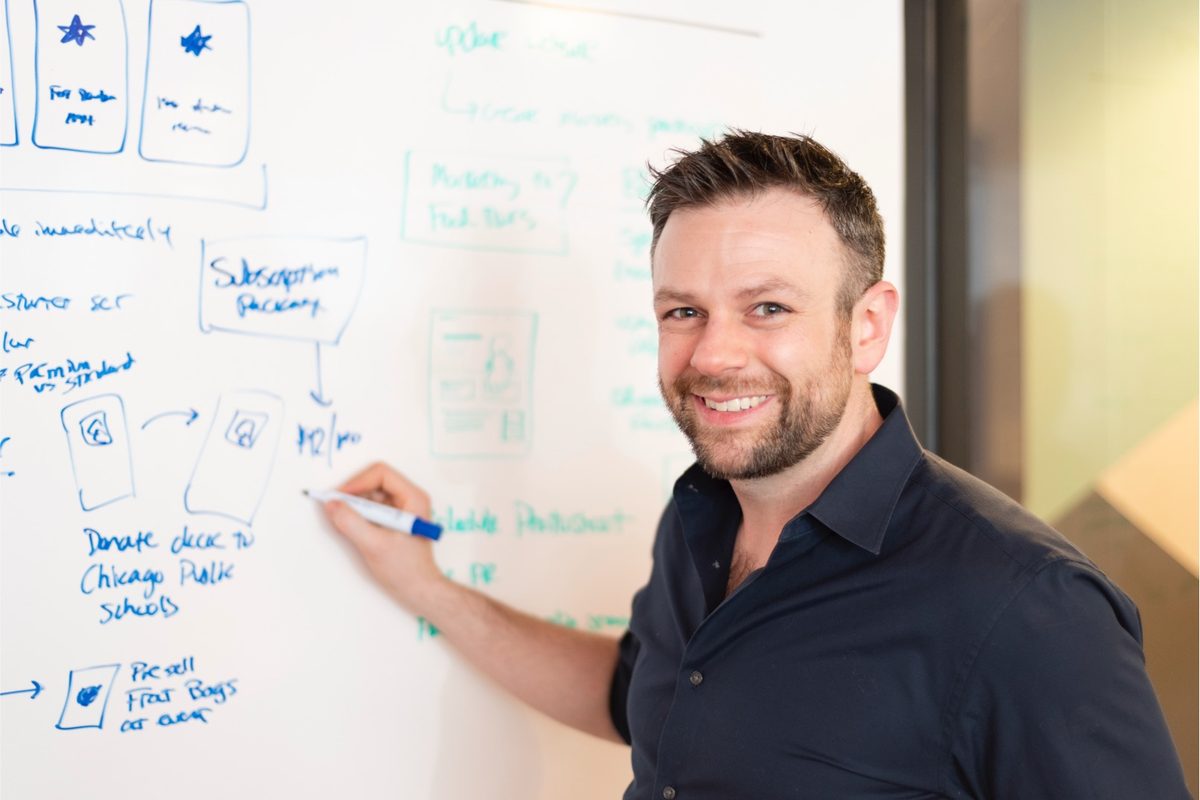
I do not use AI to plan my cycles, because the value of planning is not the plan. It is the twenty minutes you spend running the next six weeks forward in your head, noticing that the thing you scheduled for Tuesday depends on something nobody has started, and that the week you blocked for launch has two days of travel in it. A model can hand you a beautiful document without you ever running that simulation. You keep the artifact and lose the entire mechanism.
This is not a purity thing. I use AI constantly, for plenty of the work inside a cycle. I just do not hand it the deciding.
Planning works because it forces you to visualize
Something specific happens when you plan. You are forced to picture the thing before it exists.
It is closer to what an Olympic swimmer does on the block than to filling in a spreadsheet. You run the race first. Instead of letting the day happen to you, you take control of it. If you need twenty minutes with someone on Thursday, you notice that on Monday, when there is still time to ask.
Take the time to go through the day in your mind. Play it out. Know what you need to do and when you are going to do it.
That mental run-through is the part that pays. It is where you catch the roadblocks, and visualization has been shown to help people complete tasks faster. When a model writes the plan, that step simply does not happen. Nobody visualized anything. There is just a document that looks like planning happened.
The missing steps only show up when you are the one thinking
Here is the exercise I use, and it only works from the inside.
Say I put "blog article, 1.5 hours" on my sheet. I am a decent writer. Ninety minutes, easy. Then I ask "and then?" until the task runs out of hiding places:
I need to write an article.
And then? I need to find images for it.
And then? I should ask someone to proofread it.
And then? I need to get it ready to post online.
And then? I want it out on social and in the newsletter.
Now it is five tasks and a realistic number of hours. More importantly, when I wrote down "ask someone to proofread it," I was planning someone else's time as well as my own.
A model asked to break down "write a blog article" will produce a list. It will probably be a decent list. But it will be a generic list, because the model does not know that your proofreader is on holiday, that your CMS is being migrated this month, or that the last three times you did this it took four hours and not ninety minutes. You know all of that. You only surface it by being the one doing the thinking.
Humans are bad at estimating time, and AI is worse
We are terrible at this, mostly because we skip the small steps hiding inside the big ones. That is a known human failure and the method is built to counteract it, with the 90 minute rule and the "and then?" game and planning six hours in an eight hour day rather than eight.
A language model has the same weakness and none of the correction. It has never done your job, missed your deadline, or sat in your Tuesday meeting that always runs twenty minutes long. It produces confident, plausible, evenly-spaced estimates. Confident and plausible is the worst possible combination for a number you are about to build six weeks on.
What I do use AI for
Plenty. Just not the deciding.
- Doing the work I already scheduled. If Tuesday at 10am says "draft the partner email, 45 minutes," I will absolutely use a model to draft it.
- Compressing input. Summarizing a long thread so I can scope a task honestly instead of guessing at it.
- Cleanup. Formatting, reformatting, and fixing a sheet that got messy.
- Rubber-ducking. Arguing with a decision I have already thought through, to find out what I missed.
The line is simple. Use it on the work. Do not use it on the deciding what the work is.
Planning is the one place to spend more time, not less
Almost every productivity tool sold in the last two years promises to give you your planning time back. I want to argue for the opposite.
Brian Tracy's line is that every minute you spend planning saves ten minutes in execution. Whether the ratio is exactly ten to one matters less than the direction, which everyone who has run a project already knows is right.
So planning is the thing to protect. Thirty minutes at the start of every day. A full day of brain dumping at the start of a cycle, and a few days after that of catching the stragglers. If a cycle goes badly, planning is the first thing to do again rather than the first thing to cut.
When my team made planning our single focus, it became the keystone habit that everything else hung off. That is not a thing you can outsource, any more than you can outsource going to the gym and still get stronger.
The honest counterargument
The strongest case against me: a blank sheet stops people cold, and a mediocre draft you can react to beats a perfect plan you never started.
That is fair, and if you are truly frozen, having a model spit out a rough structure to argue with is better than another week of nothing. Just be clear about what you are doing. You are using it to break the freeze, not to produce the plan. The moment it is unstuck, throw the draft out and do the real pass yourself.
The other honest answer to a blank sheet is not a chatbot. It is a template that already has the structure in it, so there is no blank sheet to freeze at.